Showing posts with label Information Architecture. Show all posts

Monday, May 23, 2011

James Gleick on Information

The Information: A History, a Theory, a Flood; by James GleickGreetings from the Australian National University in Canberra, where author, James Gleick, is talking about his new book "The Information: A History, a Theory, a Flood".

Mr. Gleick told an anecdote about Zick Rubin having difficulty convincing the authors of a wiki that he was alive. The authors had a printed book which said he was dead, which was more convincing than the living person.

Mr. Gleick then mentioned Shannon's paper "A Mathematical Theory of Communication" (1948) which provided a theory of information. He pointed out that Shannon in his youth produced a "barbed wire" communications network.

It now seems obvious that electrical and optical systems carry information, which has a separate existence from the electromagnetic forms of energy used to convey it. But this was an idea which needed to be developed.

Mr. Gleick's gift is to make esoteric theoretical ideas, first chaos theory and now information theory, accessible to a wider audience. Unlike "A Brief History of Time", where Stephen Hawking tries to explain advanced physics (and fails), James Gleick mostly succeeds. His success may be due to the same advice Cameron Chamberlain gave in his Introduction to Animation last week: make it about something alive, with a personality. Facts about things are boring, but stories about people doing things are interesting.

It is important to realise that great inventions do not spring inevitably from accumulations of information. It takes people with passion. It is curious and informative that information is fundamental to life.

At question time one of the audience asked about a quote attributed to an Australian, envisaging an online computer database linked by telecommunications in 1948. Mr. Gleick said he doubted that this was said in 1948. I recalled something like this attributed to Australian computer pioneer, Trevor Pearcey. It took me a few minutes searching to find the reference:
“in the non-mathematical field there is scope for the use of the [computing] techniques in such things as filing systems. It is not inconceivable that an automatic encyclopaedic service operated through the national teleprinter or telephone service will one day exist.”
This is attributed to "Pearcey, T.: Modern Trends in Machine Computation. Aust. J. Science X/4 Supp. (1948) in John Deane's paper "Connections in the History of Australian Computing", in "History of Computing: Learning from the Past: IFIP WG 9.7", (International Federation for Information Processing, 2010). It turns out that these are the proceedings from a conference at the World Computer Congress 2010, I attended in Brisbane, last year.

James Gleick is also speaking 24 May at the Brisbane Irish Club.

ps: The Australian Information Commissioner, Professor John McMillan, will be launching a new set of "Principles on Open Public Sector Information", at Meta 2011, ANU University House, 25 May 2011.

Tuesday, May 17, 2011

Meet James Gleick: Author of The Information in Canberra, 23 May

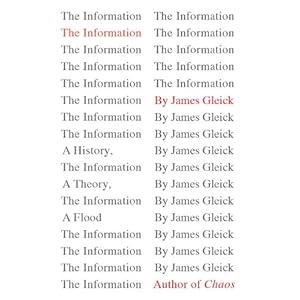
The Information: A History, a Theory, a Flood; by James GleickBest-selling author, James Gleick, will talk about his new book "The Information: A History, a Theory, a Flood" at the Austrlaian National Unviersity, in Canberra, 6.30PM, 23 May 2011. Free entry but booking is essential.

James Gleick is also speaking in Australia in May at: 19th Sydney Writers Festival, 22nd Sydney: “Perish the Thought”, 24th
Brisbane Irish Club.
  • Hardcover: 544 pages
  • Publisher: Pantheon (March 1, 2011)
  • Language: English
  • ISBN-10: 9780375423727
  • ISBN-13: 978-0375423727

Tuesday, August 31, 2010

Flexible digital search techniques

The ANU Research School of Humanities & the Arts is hosting "Flexibly Digital", 1-2.30 pm, 24 September 2010, at the Australian National University in Canberra. This is in conjunction with the National Centre of Biography's Life of Information symposium.

Friday Forum 2010 - Flexibly Digital

Date: Friday, 24 September 2010, 1:00pm- 2:30pm
Venue: Hedley Bull Centre, HB2, Australian National University, Canberra

Presenters:

Kerry Taylor

Dr Kerry Taylor, CSIRO ICT Centre

Basil DewhurstBasil Dewhurst, Trove project, National Library of Australia

Donald HobernDonald Hobern, CSIRO Ecosystem Sciences

Facilitator:

Paul Arthur

Dr Paul Arthur, National Centre of Biography

A special forum held in conjunction with the National Centre of Biography's Life of Information symposium. The thick, descriptive data of humanities research and the strict categorization of digital databases are not natural partners. Current developments in data representation are breaking down these barriers. This forum discusses the theory and practice of flexible digital search techniques.

Entry to the forum session is open (just drop in).

Details of the: Life of Information symposium


Friday, August 20, 2010

Life of Information in Canberra

The Australian National University is hosting a free symposium on "Life of Information: on the design and use of online dictionaries, encyclopaedias and collections" in Canberra, 24 September 2010.

Life of Information

A one-day symposium on the design and use of online dictionaries, encyclopedias and collections

Date: Friday, 24 September 2010,9am to 4pm, lunch is provided
Venue: Hedley Bull Centre, Australian National University

Presented by the National Centre of Biography, Australian National University

Paul ArthurConvenor: Paul Arthur, Deputy Director, National Centre of Biography and Deputy General Editor, Australian Dictionary of Biography

Register now by email: paul.arthur@anu.edu.au
* Attendance is free but places are strictly limited.

Graduate students who use online resources in their research, or are interested in the future of digital scholarship in the humanities and social sciences, are especially welcome to participate.

Life of Information flyer (PDF 430 Kb)


FEATURING:

Atlas of Living Australia
Austlit: The Australian Literature Resource
Australian Dictionary of Biography
Australian Medical Pioneers Index
Defining Moments
Dictionary of Sydney
Encyclopedia of Australian Science
Gallipoli: The First Day
Invisible Australians
Mapping Our Anzacs
Obituaries Australia
People Australia & Trove

SPEAKERS:

Katherine BodeKatherine Bode — Lecturer in English, University of Tasmania. From 2011, Senior Lecturer in Digital Humanities, Australian National University.

Ross ColemanRoss Coleman — Director of Sydney eScholarship at the University of Sydney Library, which provides digital archiving and publishing services to the University.

Basil DewhurstBasil Dewhurst — Project Manager, Australian Research Data Commons Party Infrastructure Project, National Library of Australia.

Stephen Due — Chief Librarian at Barwon Health, Victoria, and Editor of the Australian Medical Pioneers Index.

Emma Grahame — Editorial Coordinator, Dictionary of Sydney project.

Donald HobernDonald Hobern — Director of the Atlas of Living Australia, a project integrating information about all Australian species of plants, animals and microorganisms.

Ian JohnsonIan Johnson — Director of the Archaeological Computing Laboratory and Deputy Director of the Digital Innovation Unit, University of Sydney.

Tim Sherratt — Digital historian and web developer known for his work on innovative digital projects with national collecting institutions.

Kerry TaylorKerry Taylor — Research Scientist at the CSIRO Information and Communication Technologies Centre.

Thursday, October 04, 2007

Information architecture

Greetings from the Eleventh Canberra WSG meeting which just finished here at the National Library of Australia in Canberra.

Donna Maurer, from Maadmob Interaction Design talked on Information architecture - Beyond the hierarchy.

She said how strict and polyhierarchies are common for government web site designs, but there are alternatives, such as metadata-driven database, faceted classifications (sorted by attributes of entities), organic structures and tagging. Wikipedia is an example of a hypertext structure (which really is not a structure at all). She pointed out that organisation web pages need not be structured by the structure of the organisation, but by the subject area the organisation deals with.

What occurred to me that perhaps Information Architects could have a future as management consultants. They could first design the web site to match what the customer needs and then restructure the organisation to match. An advantage of this is that management consultants get paid a lot more than web designers. ;-)

Andrew Boyd, SMS Management & Technology, on prototyping as part of the web design process:

This was a detailed examination of something mentioned in a previous presentation. He described prototypes and their benefits. He demonstrated a web interface prototype tool AXURE. To me this looked like any of a number of user interface design tools and I wonder if it may be better if the designer used whatever the developers were using. However, as pointed out, the prototype tool can simulate complex AJAX applications. Another buzzword used was "wire framing". The example he showed was of the Pharmaceutical Benefits Scheme schedule on a PDA. This would be a good use for a prototype tool as it would need a difference interface to the average web page.

One worry I have is that much of what web designers are doing is reinventing software development techniques, by trial and error. It would be of advantage if they studied the tools and techniques for software engineering which have been developed over several decades. Also software developers could learn about being more responsive to client needs from web designers.